Exploring the Meaning of Barsabas in Greek
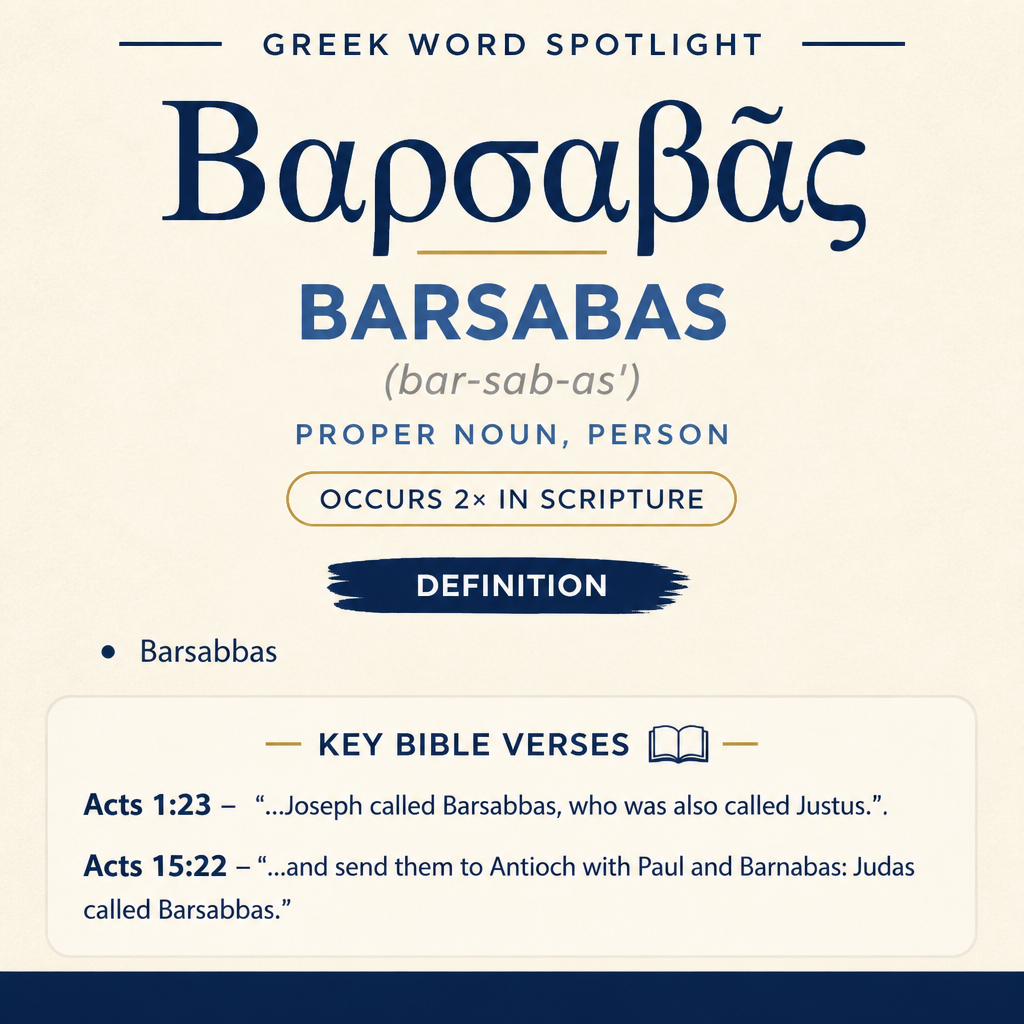
Βαρσαβᾶς means “Barsabbas” and appears twice in Scripture, in Acts 1:23 and Acts 15:22.
Acts References
In Acts 1:23, Joseph is called Barsabbas and also called Justus. In Acts 15:22, Barsabbas appears in the context of chosen men from the assembly.
Learn More →Βαρσαβᾶς (Barsabas) is a personal name rendered “Barsabbas.” It appears in Acts in two scenes where it helps distinguish prominent individuals within the early assemblies.
Occurrences
“They put forward two, Joseph called Barsabbas, who was also called Justus, and Matthias.” (Acts 1:23)
Here Βαρσαβᾶς functions as an identifying name within a careful process of nomination. The line presents “two” candidates side by side, and the name “Barsabbas” is attached to “Joseph” as part of a fuller identification: “Joseph called Barsabbas, who was also called Justus.” Within the sentence, the word contributes precision. Since the community is presenting candidates in a consequential moment, the double naming (“called Barsabbas … also called Justus”) marks this Joseph as a specific, recognized person rather than an indistinct figure. The structure also places “Barsabbas” as a label used in common reference (“called Barsabbas”), while the additional name “Justus” further anchors his identity, suggesting he was known under more than one designation in that setting.
In terms of how the verse reads, “Barsabbas” is not simply an ornament; it is part of the way the group publicly presents and differentiates two individuals. The word stands at the center of a cluster of identifying elements: a personal name (“Joseph”), a called-name (“Barsabbas”), and an additional called-name (“Justus”). This compact naming sequence contributes to the narrative’s clarity by ensuring that the person under consideration can be recognized in the community’s memory and discourse.
“Then it seemed good to the apostles and the elders, with the whole assembly, to choose men out of their company, and send them to Antioch with Paul and Barnabas: Judas called Barsabbas, and Silas, chief men among the brothers.” (Acts 15:22)
In this occurrence, Βαρσαβᾶς again appears in a naming formula, now attached to “Judas.” The verse situates the action as a corporate decision: “the apostles and the elders, with the whole assembly,” choose representatives “out of their company” to be sent “to Antioch with Paul and Barnabas.” Against that institutional and communal backdrop, the word “Barsabbas” serves to specify which Judas is meant—“Judas called Barsabbas”—before the text pairs him with “Silas” and characterizes them as “chief men among the brothers.”
The name therefore contributes both identification and public standing. Identification comes through the same “called” construction seen in Acts 1:23; standing comes through the appositional phrase “chief men among the brothers,” which frames Barsabbas (as Judas’s called-name) within recognized leadership. The narrative is concerned with sending accredited messengers, and the name participates in that accreditation by tying the mission to known persons. In the flow of the sentence, “Judas called Barsabbas” occupies the first slot after the decision “to choose men,” so the name marks the person as one of the selected emissaries and prepares for the description that follows.
Sense and Usage
Across these two verses, Barsabbas appears as a stable personal designation used to single out a particular individual when other names might be shared. Both contexts present the name within a “called” formula (“called Barsabbas”), which portrays it as a recognized label by which the person is known in the community’s speech. That usage places Barsabbas in the sphere of public identification: it is the kind of name that can be invoked in formal settings—nominating candidates in one case, appointing emissaries in another—without further explanation. The narrative expects readers to accept the designation as sufficient to point to the correct individual.
The two occurrences show Barsabbas functioning in two different naming clusters. In Acts 1:23, it attaches to “Joseph” and is immediately followed by another called-name (“also called Justus”), producing a layered identification that narrows the referent step by step. In Acts 15:22, it attaches to “Judas” and is paired with “Silas,” with the added description “chief men among the brothers,” which places the named person among leading representatives. In both cases, Barsabbas works as a distinguishing personal name within a community where multiple individuals may share more common names.
Although the name belongs to different individuals in the two scenes (one Joseph, one Judas), the narrative use is similar: Barsabbas serves as a clarifying tag that keeps the account anchored to particular persons and their recognized roles. The form “called Barsabbas” is especially suited to settings where names must carry weight in communal decisions. In Acts 1:23 the decision-making context is implicit in the act of “put[ting] forward two,” which requires unambiguous identification of candidates. In Acts 15:22 the decision-making context is explicit and corporate, and the name helps identify one of the chosen men who will accompany well-known figures (“Paul and Barnabas”) to another location (“Antioch”).
Imagery and Setting
In these passages, Barsabbas carries the imagery of public naming in communal life: a person being put forward or sent out under a recognized designation. Acts 1:23 evokes a scene of selection in which names are spoken and candidates are clearly delineated—“Joseph called Barsabbas, who was also called Justus, and Matthias.” Acts 15:22 evokes a scene of official sending in which chosen men are named and characterized—“Judas called Barsabbas, and Silas, chief men among the brothers.” In both settings, the name operates as a marker of identity within shared memory and public action.
Sources: Lexical data from Strong’s Exhaustive Concordance and the Translators Brief Lexicon of Extended Strongs for Greek (STEPBible, CC BY). Occurrence data from the Translators Amalgamated Greek New Testament (STEPBible, CC BY). Scripture quotations from the World English Bible (public domain).